Battling Australia force series decider as questions grow for Pakistan

Contents
The Big Picture: Australia’s Grit Sets Up a Thrilling Finale
The ongoing ODI series has served as a fascinating throwback to an earlier era of cricket. In an age dominated by massive power-hitting and skyrocketing scores, this series has offered a nostalgic 1990s vibe, where every run has to be hard-earned. After Pakistan outplayed the visitors in the opening match, a heavily patched-up Australian side showed incredible adaptability to bounce back in the second game. While a score of 200 was not enough for Australia in the opener, a gritty 231 proved more than sufficient to defend in the second match, perfectly setting the stage for a mouth-watering decider in Lahore.
Australia’s resurgence was built on sheer determination. Josh Inglis and Cameron Green did the heavy lifting during the first half of the innings. For Green, it was a testing battle for rhythm, but his gritty half-century was a testament to his character. Upon reaching the milestone, he acknowledged the achievement with a relieved punch of the air. This solid foundation allowed Matt Renshaw and the highly promising 19-year-old Oli Peake to play with far more freedom in the latter stages. Peake showed maturity beyond his years; after starting slowly with 6 runs from 15 deliveries, he refused to panic and eventually dispatched vital late sixes to boost the total.
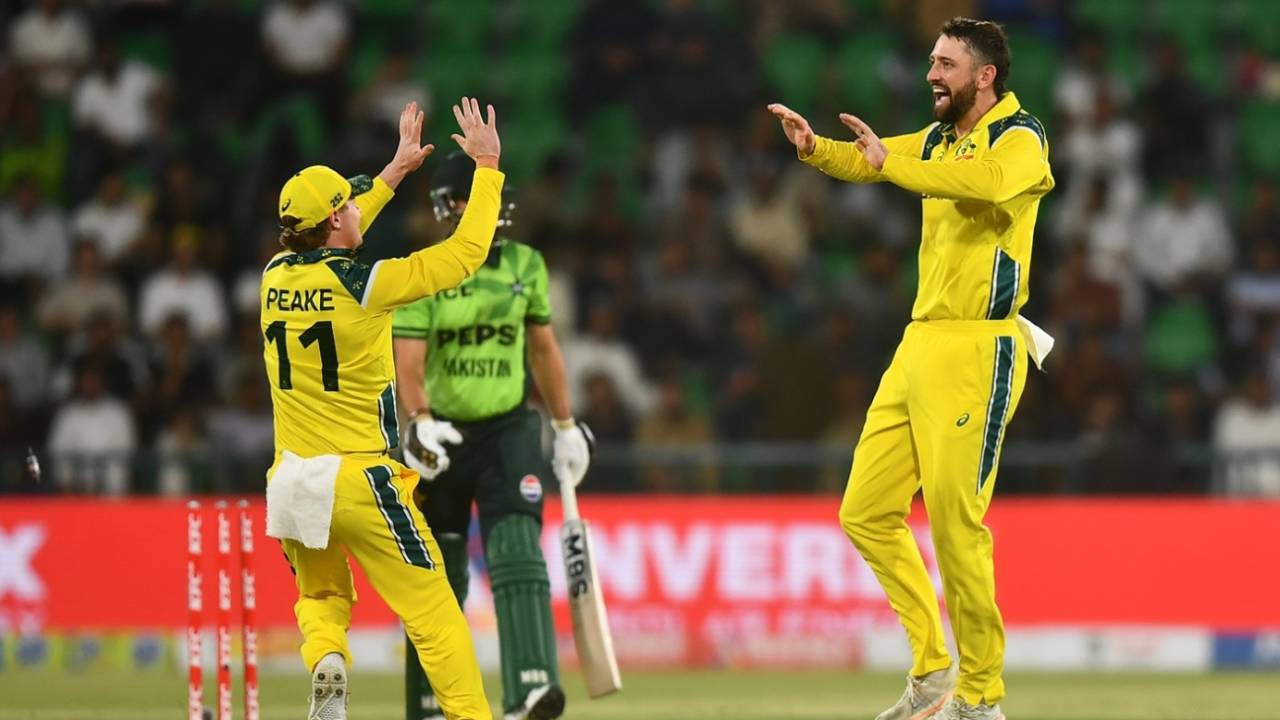
With the ball, Australia adapted brilliantly to the slow, grippy surface. Nathan Ellis led the attack with a superb career-best performance, proving perfectly suited to the conditions. The spinners played their supporting roles flawlessly, with part-timer Matt Short providing bonus value by picking up three wickets. Short’s delivery that slid past Salman Agha’s outside edge was a particular highlight of an exceptional bowling display.
Meanwhile, Pakistan find themselves facing tough questions. Ahead of the second game, coach Mike Hesson defended the slow home pitches, only for his side to be hoisted by their own petard. While young prospects like Arafat Minhas (who shone with both bat and ball) and wicketkeeper-batter Ghazi Ghori showed plenty of promise, significant concerns remain. Shadab Khan’s bowling struggles continued, though his fighting knock of 71 kept Pakistan in the contest. However, his runs might have muddied the waters regarding the team’s long-term tactical balance. Since 2015, Pakistan has lost only one home bilateral ODI series. Coming off a recent disappointing series loss in Bangladesh, a defeat in Thursday’s decider would only deepen the uncertainty surrounding the national team’s direction.
Form Guide
Pakistan: L, W, L, W, L (most recent first)
Australia: W, L, L, W, W
In the Spotlight: Sahibzada Farhan and Matt Renshaw
Sahibzada Farhan (Pakistan)
Sahibzada Farhan has built a strong reputation as an explosive top-order option in domestic and international T20s, but transitioning that success to the 50-over format has proved challenging. Across five ODI innings, Farhan has managed three promising starts but has failed to convert any of them into a substantial score. In the first match, he threw his wicket away by picking out long-off. In the second game, his struggles compiled when he top-edged a sweep in just the second over, leaving Pakistan reeling early after already losing his opening partner.
Matt Renshaw (Australia)
Conversely, Matt Renshaw has stood out as the most fluent batter across both teams in these challenging, low-scoring conditions. The elegant left-hander has extended his excellent white-ball form by showcasing smart placement, energetic running between the wickets, and a clinical ability to punish loose deliveries. His only minor slip-ups have been his inability to stay until the very end to close out the innings, though both of his dismissals came against high-quality deliveries. Given his current touch, there is a strong case for promoting him higher up the batting order.
Team News and Selection Dilemmas
Pakistan
Pakistan’s management has opted for consistency, remaining unchanged through the first two games. Shadab Khan’s valuable contribution with the bat is highly likely to secure his place in the starting XI, given the balance he provides to the lower-middle order. While there is a loud clamour from fans and pundits to include left-arm spinner Sufyan Moqim, fitting him into the lineup remains a tactical headache unless selectors decide to drop a specialist batter or play with only one frontline fast bowler.
Pakistan (Probable XI): 1 Sahibzada Farhan, 2 Maaz Sadaqat, 3 Babar Azam, 4 Ghazi Ghouri (wk), 5 Arafat Minhas, 6 Salman Agha, 7 Abdul Samad, 8 Shadab Khan, 9 Shaheen Afridi (capt), 10 Haris Rauf, 11 Abrar Ahmed.
Australia
While Australia’s initial strategy for this bilateral tour might have been to rotate their squad and give every player an opportunity, the balanced XI fielded in the second match performed exceptionally well. As a result, uncapped bowling all-rounder Liam Scott will likely have to wait a bit longer to make his international debut. Marnus Labuschagne remains under heavy scrutiny after missing out twice in this series, continuing a lean patch of form in ODI cricket. While he might retain his spot for the decider, the Australian coaching staff could seriously consider elevating the in-form Matt Renshaw to maximize his utility.
Australia (Probable XI): 1 Alex Carey, 2 Matt Short, 3 Josh Inglis (capt & wk), 4 Marnus Labuschagne, 5 Cameron Green, 6 Matt Renshaw, 7 Oli Peake, 8 Matt Kuhnemann, 9 Nathan Ellis, 10 Adam Zampa, 11 Tanveer Sangha.
Pitch and Conditions: Expect More Spin Dominance
Unless the groundstaff in Lahore drastically alter their preparations, fans should expect another match dominated by slow bowlers. The pitch is anticipated to remain slow and low, demanding tremendous patience and physical exertion from the batters. Players will also have to contend with another hot day, alongside a minor forecast of rain that could potentially interrupt play.
Key Stats and Historical Trivia
- Adam Zampa’s Milestone: The leg-spinner needs just three more wickets to become only the seventh Australian male bowler to achieve the milestone of 200 ODI wickets.
- A Long Drought: Australia has not secured an ODI series victory on Pakistani soil since 1998, though this statistic is skewed by a massive 24-year gap between bilateral tours to the country.
- Babar’s Nemesis: Nathan Ellis has dismissed Pakistan’s star batter Babar Azam three times in just five ODI encounters—the joint-highest number of times any bowler has dismissed Babar in this format.
Key Quotes from the Camps
Reflecting on the defensive lapses in the second match, Pakistan captain Shaheen Afridi observed: “I think we gave away 20-30 extra runs towards the end. We lost wickets early on and that built pressure on us.”
Australian paceman Nathan Ellis shared his thoughts on the unique playing conditions: “It looks a little bit different to the traditional one-day cricket we’re seeing around the world at the moment, but I do think there’s a place for it too.”