
Contents
A Hard-Fought Session at Trent Bridge
New Zealand have systematically tightened their grip on the deciding Test of the series at Trent Bridge, moving into a commanding position despite a heartbreaking near-miss for one of their rising stars. By the time the players headed for the lunch break on day four, the Black Caps had reached 180 for 4, extending their lead over England to 264 runs. While the scoreboard reflects a healthy advantage, the morning session was characterized by a grueling battle against an increasingly unpredictable pitch.
The Ravindra-Mitchell Partnership
The core of the morning’s resilience came from the partnership between Rachin Ravindra and Daryl Mitchell. Throughout 23.4 overs, the pair added 60 runs, a rate that might seem modest in modern cricket but was vital given the conditions. They prioritized survival and steady accumulation, successfully pushing their partnership into three figures. This period of play highlighted the sheer difficulty of batting on a surface where variable bounce became a primary antagonist for the batters.
Rachin Ravindra, who had looked in fine touch, was cruelly denied a sixth Test century. Just five minutes before the lunch interval, Ben Stokes turned to spin, introducing Shoaib Bashir. The move paid immediate dividends when Bashir bowled a delivery that kept uncharacteristically low. Ravindra, playing back, was trapped lbw, ending his resolute innings on 94.
England’s Frustration and the Variable Bounce
For England, the morning was a lesson in persistence. Despite a tireless effort from their four-man seam attack, wickets remained elusive for the vast majority of the session. Ben Stokes, in particular, was exceptional, bowling a demanding eight-over opening spell that yielded only 14 runs. The England captain continuously tested the batters with movement and dangerous short-pitched bowling.
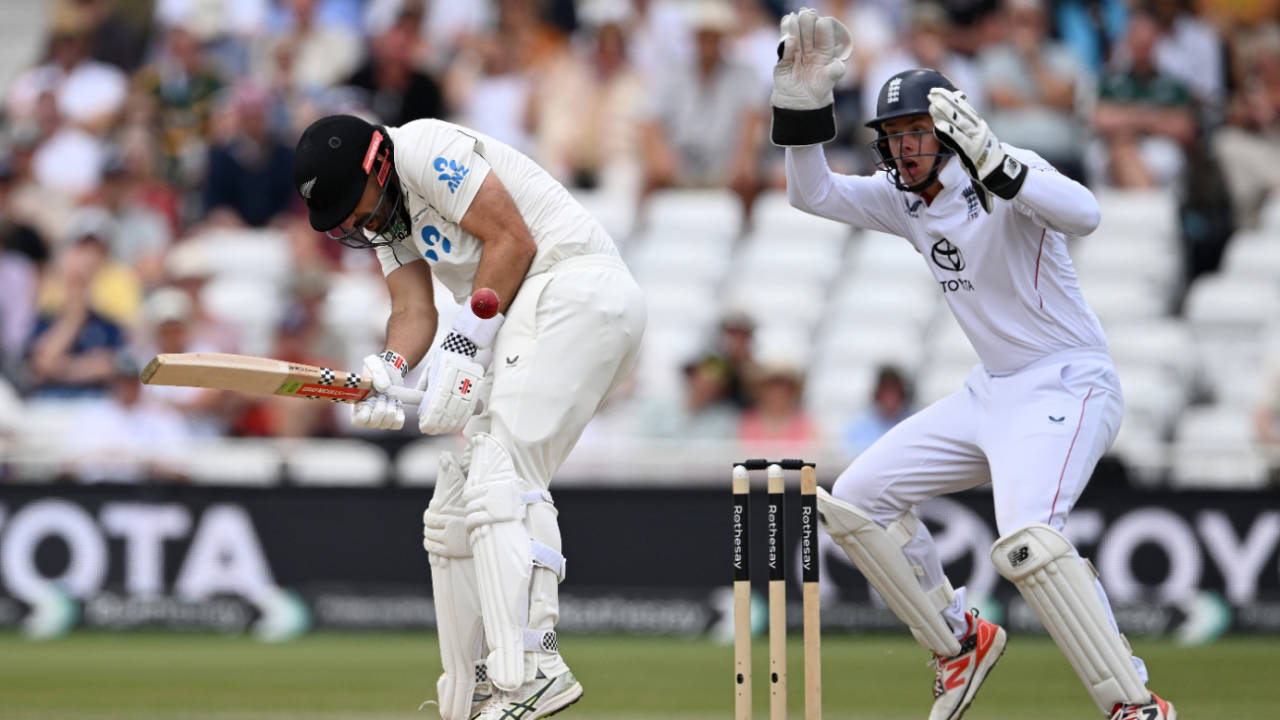
The intensity of the contest was underscored by several dramatic moments. Early in the morning, Daryl Mitchell was given out lbw to Jofra Archer, but a review proved the ball would have cleared the stumps. Mitchell, who celebrated the reprieve with visible relief, found himself under constant physical pressure thereafter. He endured a bruising spell, taking multiple blows to his hands and body as Stokes exploited the surface’s variable bounce. Mitchell’s stoic nature was tested as he managed only six runs in the first 55 minutes of play, followed by a long period without scoring as the break approached.
The Physicality of the Contest
The pitch at Trent Bridge provided a stern test of character. The ball consistently misbehaved, leading to a physical toll on the players. Mitchell was struck on the forearm by Stokes, and on at least two other occasions, the ball rapped his gloves painfully. Even the wicketkeeper, Jamie Smith, was not spared; when one delivery veered sharply past the outside edge, the ball struck him on the grille of his helmet while he was standing up to the stumps.
Ravindra, by contrast, displayed slightly more fluidity in his shot-making. He executed a firm pull through midwicket off Stokes and looked comfortable whipping Archer off his pads. His progression into the 90s included a thick edge for four and a controlled clip, yet he was ultimately unable to convert that momentum into a triple-figure score.
Looking Ahead
With a lead of 264 runs, New Zealand are currently dictating the terms of the game. Daryl Mitchell remains at the crease, joined by Tom Blundell, and the focus for the visitors will be to bat England out of the game entirely. The pitch shows every sign of becoming more treacherous as the match progresses, suggesting that chasing a target on this surface will be a monumental task for the English side. As it stands, the Black Caps are firmly in the driver’s seat, looking to close out the series in emphatic fashion.