
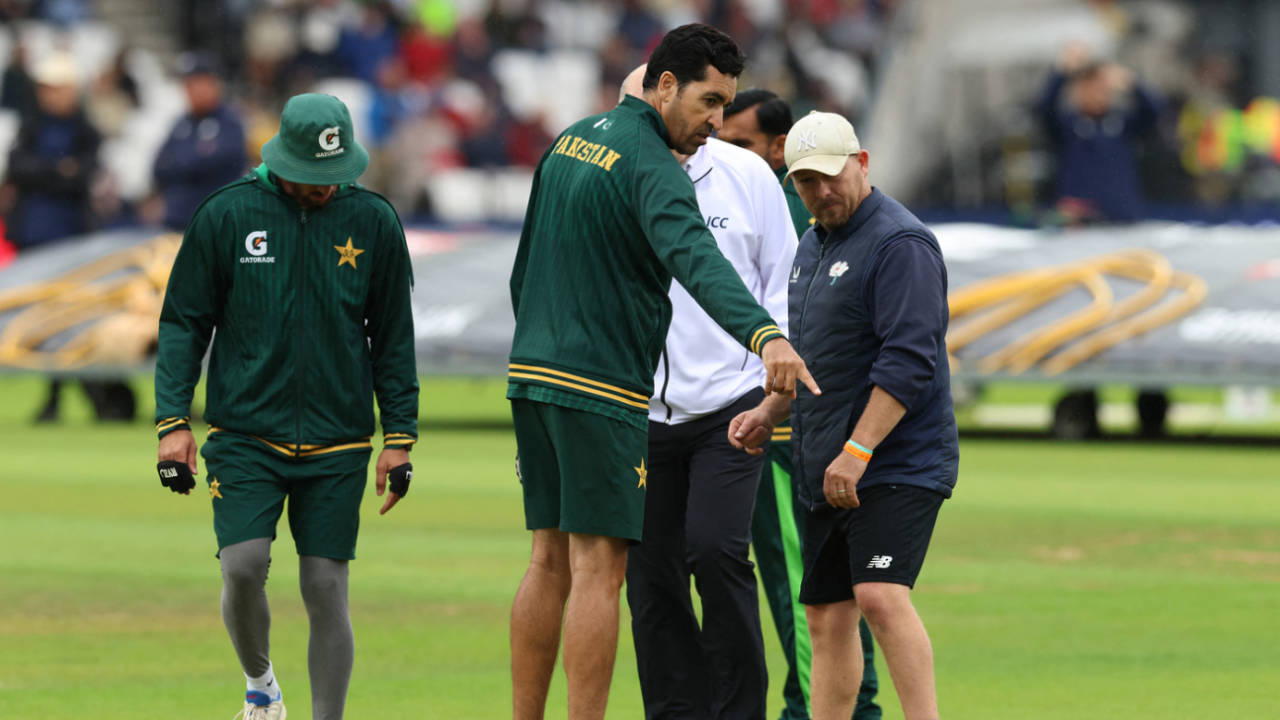
Umar Gul, a figure synonymous with Pakistani fast bowling but known for his mild-mannered disposition, recently voiced his frustration regarding Pakistan’s performance at Headingley. The team’s loss under the cool, dark skies of Yorkshire sparked considerable debate, focusing on the impotence of their quick bowlers and the batsmen’s apparent discomfort at the crease. However, as every facet of Pakistan’s disheartening display was scrutinized, Gul presented a fresh perspective, directly attributing some of the struggles to the notoriously unpredictable English weather.
Addressing the media at Lord’s, Gul elaborated on his observations. “When we came here from West Indies, the weather was hot. It was a hot summer,” he recalled. “We weren’t expecting it to be this cold. Even the practice match at Croydon, the weather there was hot. When we reached Headingley, it was totally different. It rained and the weather was cold.” This stark contrast, according to Gul, significantly impacted the team. “Obviously, you need to spend some time in that cold weather. That’s why we couldn’t bowl that well, and we couldn’t execute due to the weather. But I hope they acclimatise with the weather and do well in the next game.”
It speaks volumes about the challenges confronting Pakistan cricket when the team appears to place a greater reliance on the vagaries of UK weather forecasts than on their established game plans. While the initial warm-up game in Beckenham indeed offered favorable, warm conditions, Gul’s comments suggest that the drastic change upon arrival in Yorkshire caught the touring side off guard. Building a strategy on the assumption that the hot weather prevalent in the south of England would persist as the squad journeyed north seems, in hindsight, a precarious foundation, one that swiftly crumbled under the real-world conditions at Headingley.
The Impact of Temperature on Fast Bowlers
Gul firmly believed that the difficulties in acclimatizing were a primary reason for the fast bowlers’ relative ineffectiveness during the first Test. England’s batsmen capitalized on this, needing to bat only once to accumulate a commanding total of 409 runs. “Because of the [change in temperature], I thought the bowlers were a little stiff. You have to get used to the weather. And I hope they’ll be fully ready for this next game,” he asserted. This stiffness, a natural physiological response to sudden cold, can significantly impede a fast bowler’s rhythm, pace, and control, making it challenging to hit consistent lines and lengths, especially against well-set Test batsmen.
The former speedster also touched upon the strategic decisions made leading up to the Test. “In the days leading up to the Test, we considered going in with four seamers. But on the day before the match, the pitch we saw had changed quite a bit, and playing a spinner turned out to be a good decision. But when you come here, you need time.” This highlights a critical dilemma for touring teams in England, where pitch conditions can evolve dramatically with weather changes, forcing last-minute tactical adjustments that might not always align with the team’s preparations or strengths.
Frustration and Future Prospects
For Gul, there’s an understandable layer of frustration concerning factors beyond his control. A veteran of English cricket, both internationally and on the county circuit, he would undoubtedly have been a valuable asset to any Pakistani pace attack throughout his career. He is acutely aware that he cannot magically imbue the current crop of bowlers with greater pace or experience. While he spoke highly of Ubaid Shah as a promising future prospect, he acknowledged that his potential inclusion might mean sacrificing some valuable experience for an extra yard of pace, a trade-off that requires careful consideration in Test cricket.
Most notably, Gul subtly deflected a question regarding Shaheen Afridi, who had recently led his domestic side to a one-day cup trophy, directing the query towards the selection committee. However, not before he pointedly referred to Afridi as “Pakistan’s best bowler.” This comment, while diplomatic, underscored a clear sentiment about the prominent left-armer’s value to the national side.
“Maybe they thought it was better to give him some rest. He’s our best bowler, but our other bowlers are also doing well. Especially Ubaid Shah, he performed very well, and we’re expecting big things from him in the future. Abbas and Mohammad Ali were playing county cricket which is an advantage for us because they were available here. But I think the selection committee can give you a better answer about Shaheen.” This response highlights the intricate politics and decision-making processes within Pakistani cricket, often leaving fans and commentators questioning the rationale behind key selections.
If there is one element that rivals the capriciousness of the English weather, it is perhaps the rapidly shifting moods and policies of any Pakistani selection committee. It creates an unenviable situation when a figure as gentle-spirited and knowledgeable as Umar Gul finds himself contending with both, attempting to articulate the challenges faced by his national team in a climate of high expectations and unpredictable circumstances.