Brook and Salt blow India away as England romp to series win, Dominating T20I Series

While England’s Test cricket fortunes may currently face challenges, their T20 international side continues to demonstrate unparalleled prowess on the global stage. In a display of sheer dominance, England romped home with 37 balls to spare in Bristol, securing a historic milestone: their first-ever series victory over India in this format. This commanding performance has significant implications for the ICC rankings, as England stands poised to displace the reigning world champions as the No. 1 T20I side if they can clinch a clean sweep in the upcoming match in Southampton.
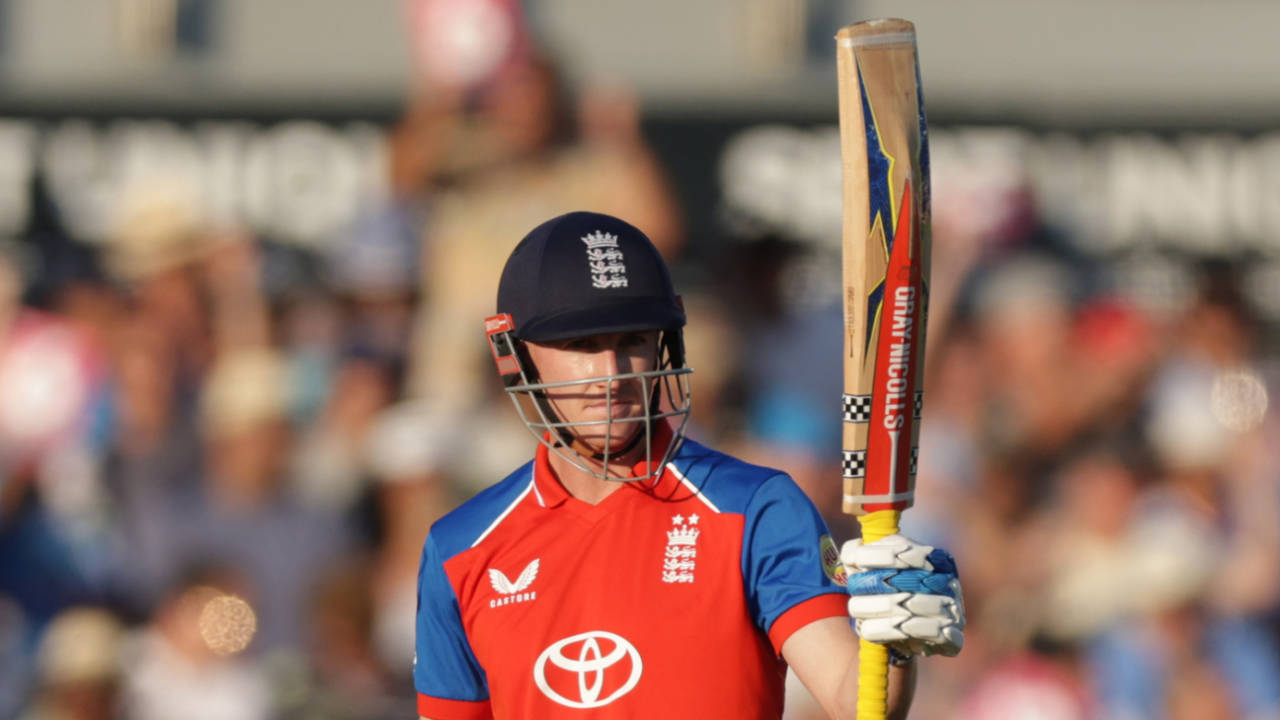
The celebratory moment saw Phil Salt punching gloves with his captain, Harry Brook, as he deftly knocked Arshdeep Singh‘s delivery out to point, jogging through for the winning run. This marked the culmination of an unbroken second-wicket partnership that amassed an astonishing 146 runs off just 70 balls, delivering yet another decisive annihilation of India. This clinical performance mirrored their previous commanding 125-run win at Trent Bridge, underscoring England’s consistent superiority.
Under Harry Brook’s captaincy, which began last year, England’s T20I side has been on a remarkable trajectory, winning 19 out of 22 completed matches. Following a closely contested victory in Manchester, their dominance in both subsequent matches this week has been absolute. This success is underpinned by a vastly experienced squad, with five players boasting 60 or more T20I caps, and a tactical approach characterized by simple yet profoundly effective plans to dismantle their Indian opponents.
From England’s perspective, the only regrettable aspect of this formidable run is the distant prospect of the next T20 World Cup, still over two years away. While they narrowly missed chasing 254 against India in the 2026 T20 World Cup semi-final in March, this series, though not a World Cup contest, undoubtedly serves as a form of sweet revenge, affirming their current strength.
Conversely, this series marks a historic low for India, as it represents the first time in their history that they have lost five successive men’s T20Is. The weight of this result falls heavily on their new captain, Shreyas Iyer, who finds himself under significant pressure barely two weeks into his tenure. Reflecting on the team’s struggles, Iyer acknowledged the situation: “This is the transition phase and we will be making a lot of mistakes. Again, it was a disappointing one.”
Brook and Salt’s Masterclass in Batting
England’s chase began with a rare occurrence: Phil Salt faced a second successive first-over maiden, though Arshdeep Singh conceded four leg byes. Arshdeep did manage to strike in his second over, claiming the wicket of Jos Buttler, who edged behind after launching a straight six. However, Harry Brook quickly asserted his authority, scooping Arshdeep for six, effectively neutralizing the bowler, who was not brought back for a third over until the game was a foregone conclusion.
Phil Salt, initially slow to get off the mark, turning 0 off 9 balls, soon found his rhythm with an explosive burst, transforming his score to 26 off 19 deliveries. He expertly carved both Prince Yadav and then Prasidh Krishna for three fours in an over, showcasing his expanding repertoire of strokes. While Prince Yadav momentarily rearranged Salt’s stumps with a pinpoint yorker, it was off a free hit, due to an overstep, denying India the wicket. Another elegant lap shot from Brook ensured England reached a formidable 62 for 1 after the powerplay, setting a blistering pace.
When Indian captain Shreyas Iyer introduced Washington Sundar’s off-breaks, Harry Brook immediately recognized an opportunity to decisively shift the momentum of the game. Seizing the moment with audacious confidence, Brook launched into a brutal assault, hitting four, six, four, and then another four in successive balls. This onslaught dramatically reduced the required run rate to a mere run-a-ball. His breathtaking acceleration culminated in a magnificent 21-ball fifty, achieved with a powerful straight launch for six off Axar Patel. Not to be outdone, Salt reached his own fifty off 34 balls, elegantly flicking Prasidh for four, ensuring that the pressure on the Indian bowlers never relented.
England’s Bowling Strategy: The Short Stuff Works Again
Following their successful execution in Nottingham, England’s bowlers once again employed a potent short-ball strategy to devastating effect in Bristol, dismantling India’s top order with pace and aggression. For the third consecutive game, Vaibhav Sooryavanshi struggled to make an impact, falling before reaching 15. Ishan Kishan followed suit, succumbing to a cross-batted shot against a short ball early in his innings, highlighting the effectiveness of England’s tactical approach.
The middle order offered little resistance, with both Abhishek Sharma and Shivam Dube failing to establish themselves before falling to mis-hits off spin. Dube’s dismissal was particularly notable, falling victim to another excellent catch at long-on by Tom Banton, whose fielding throughout the series has been consistently brilliant. On a pitch that exhibited varying pace and bounce, both Tilak Varma and Washington Sundar were caught off well-executed slower-ball bouncers, further demonstrating England’s intelligent use of variations and conditions.
It was another highly successful evening for England’s pacemen, Jofra Archer and Josh Tongue, who collectively shared four crucial wickets, maintaining relentless pressure on the Indian batsmen. Sam Curran proved exceptionally effective on a surface that perfectly suited his style, conceding a miserly 24 runs from his full quota of four overs. Will Jacks was nearly as economical, finishing with impressive figures of 1 for 28, having bowled his full allocation for the first time in a T20I on home soil, showcasing the depth and versatility of England’s bowling attack.
Shreyas Iyer’s Valiant Lone Hand
Amidst India’s widespread batting struggles throughout the series, Shreyas Iyer emerged as the team’s sole reliable source of runs. He remarkably scored more half-centuries (two) than the rest of India’s batsmen combined (one). Iyer found himself at the crease early once again in Bristol, immediately flicking his second ball for four, a clear sign of his intent. He then produced an outrageous upper-cut for six, exploiting the shorter straight boundaries with audacious skill when Jofra Archer returned for his third over, demonstrating his ability to take on the best.
Iyer was the only Indian batsman to play with any real conviction, taking on England’s attack with courage and flair. He particularly targeted Adil Rashid, dismantling the leg-spinner in style. A remarkable 44 of the 49 runs Rashid conceded came off Iyer’s bat, including a spectacular sequence of six, four, six at the end of the 18th over, Rashid’s last. While the four came via a thick outside edge, the two sixes were quintessential Iyer, dancing down the pitch and launching the spinner back over his head with commanding power and precision.
Despite Iyer’s heroic efforts, which saw India reach 150 for 5, the team managed a paltry four runs off each of the last two overs. Sam Curran and Jofra Archer expertly nailed their slower balls and yorkers, stifling any hopes of a late surge. Archer’s side-footed finish to run out Axar Patel off the innings’ final ball encapsulated India’s struggles. Iyer was desperately short of support; he struck four fours and five sixes, while his teammates collectively managed just five fours and two sixes, highlighting the stark contrast in performance.
This comprehensive series victory for England underscores their formidable position in T20 international cricket, built on aggressive batting, disciplined bowling, and cohesive team strategy. For India, it presents a critical juncture, necessitating a re-evaluation of their approach and personnel to navigate this challenging transitional phase.