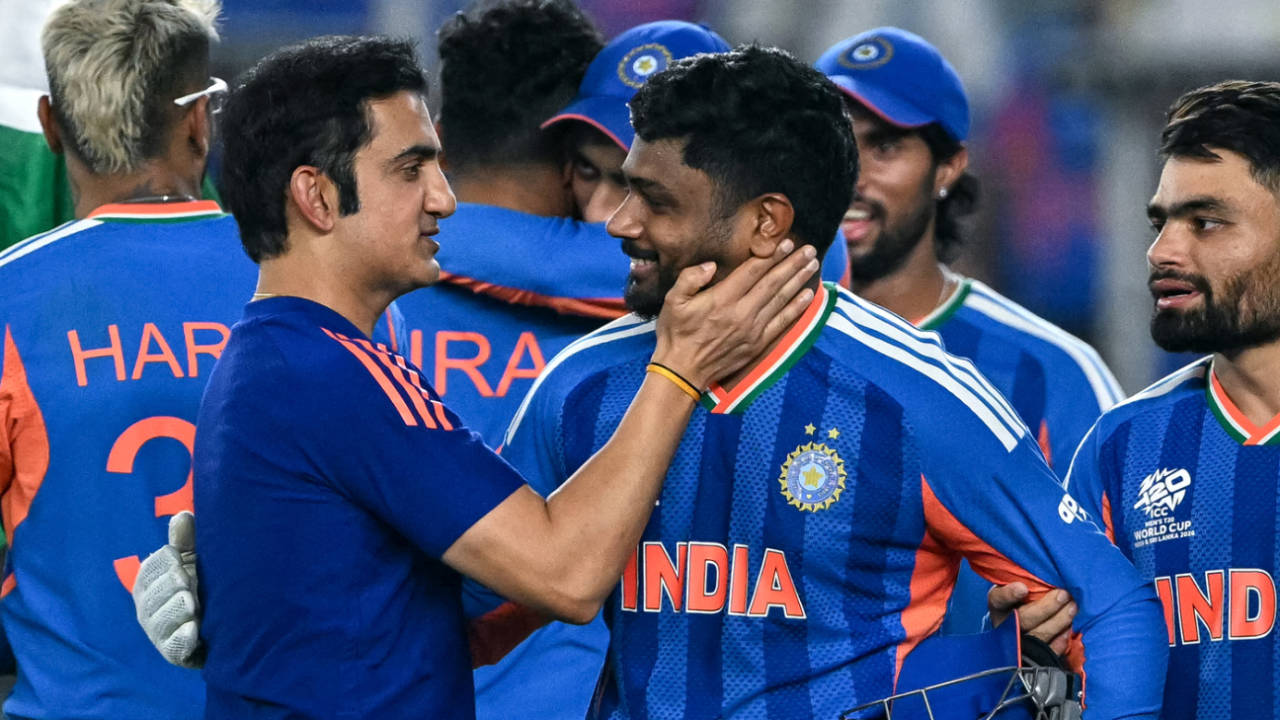
India’s head coach, Gautam Gambhir, has addressed the situation surrounding Sanju Samson’s exclusion from the playing XI and, subsequently, the squad slated to tour Zimbabwe for a three-match T20I series. Gambhir stated firmly that he has provided Samson with the necessary clarity regarding these significant decisions.
Contents
Gambhir Addresses Samson’s Omission Amidst Stellar and Struggling Form
Sanju Samson’s recent cricketing journey has been a rollercoaster of exceptional highs and perplexing lows. He was a pivotal figure and the undisputed Player of the Tournament in the T20 World Cup held in March, where his performances were nothing short of phenomenal. Samson registered scores of 97 not out, 89, and 89 in the last three matches of that prestigious tournament, showcasing his immense talent and ability to perform under pressure. His stellar form continued into the Indian Premier League (IPL), where he notched up two centuries, further solidifying his reputation as a dynamic batsman.
However, a dip in form during the recent tours of Ireland and England saw Samson post scores of 5, 0, and 1. This significant downturn led to his exclusion from the playing XI and ultimately from the squad for the upcoming Zimbabwe T20Is, with 15-year-old prodigy Vaibjhav Sooryavanshi being preferred. While Samson remains part of the wider squad currently in England, where India trails 2-0, his complete omission from the Zimbabwe series has sparked considerable discussion.
The Coach’s Stance: Clarity and Performance
Speaking after the third T20I at Trent Bridge, Gambhir shed light on the nature of his interaction with Samson. “The clarity that should have been given to Sanju Samson, he has got from me,” Gambhir confirmed. He maintained the confidentiality of their discussion, stating, “And that conversation is between a head coach and a player. The contents of the conversation we will obviously not tell you about.”
Gambhir emphasized that while Samson’s contributions during the World Cup were “phenomenal,” the current decisions are rooted in present form. “As far as clarity goes, we are absolutely clear that Sanju… what he had done for India during the World Cup has been phenomenal, and sometimes you just have to look at the form as well of a certain player. And there is no hard and fast rule that he cannot make a comeback in this series,” he elaborated.
The head coach reiterated a fundamental principle of international cricket: the pursuit of results. “More importantly, ultimately international cricket is about results. Whatever we feel is the best combination to give us the results, we play that combination, we play that playing XI. That is what he has always been a big believer of: that everyone needs to earn their place. Everyone needs to earn the right to play for India,” Gambhir asserted, underlining the meritocratic approach to team selection.
Mounting Pressure and India’s Post-World Cup Struggles
The decisions made by the selectors and team management have come under intense scrutiny, particularly after the exclusion of both the T20 World Cup-winning captain, Suryakumar Yadav, and the Player of the Tournament, Sanju Samson. This pressure is compounded by India’s dismal run of form since their historic T20 World Cup triumph. The team has suffered losses in all four of its completed matches following the World Cup, including a humiliating 2-0 clean sweep against Ireland – an opponent they had never previously lost to in international cricket.
Gambhir acknowledged the team’s need to improve in areas such as game awareness and adaptability to varied conditions. However, he also presented the current results as an expected consequence of the T20I side undergoing a significant “reset” after a prolonged period of dominance. Prior to the setbacks experienced in Ireland and England, India had enjoyed an unbeaten streak of 16 consecutive series or tournaments, culminating in becoming the first team to successfully defend a T20 World Cup title.
“Conditions matter a little but if you see there are changes in the T20 side,” Gambhir explained. “When you go to reset a side, sometimes you get such performances. There are a lot of changes from the XI that played the T20 World Cup final to now. Be it the captain, be it the opening batsman. There is no Hardik Pandya, there is no Jasprit Bumrah.”
He further elaborated on the challenges inherent in such a transitional phase: “When you go for that reset, it takes a bit of time. If you see, a 15-year-old is opening, Prince Yadav is in his second T20I, Harshit Rana is coming back from an injury. We ultimately look only at results, and no doubt results are important in international cricket, but we have to be practical as well. Sometimes you give players time to develop. England is a high-quality side. If you put players in against such teams, you have to give them time to develop. Because after a reset, things take time.”
The Imperative of Adaptability and Game Reading
Despite emphasizing the reset phase, Gambhir also stressed the critical importance of adapting to conditions and reading game situations more effectively. “I think that it is important to assess the conditions, no doubt about that,” Gambhir stated, “but it is also important [to know] how to read the game. That is equally important as well… sometimes it’s a small thing, but breeze can play a huge part as well. Sometimes one side where the dimensions are much bigger than the other side… that is important as well. So these small-small things in a T20 game can make a huge difference.”
He highlighted a specific tactical deficiency observed in recent matches: “And sometimes what happens is, when everyone in a batting line-up starts playing high risk, high reward, sometimes these things can happen. Probably the middle order, the experienced guys who have played enough international cricket, need to adapt and probably play according to the situation as well.”
Gambhir drew a comparison to the successful World Cup campaign to illustrate his point: “We did that during the World Cup as well. Our top three were firing and we wanted to play that high risk, high reward, but then we had [Nos.] 4 or 5 who were still able to build the innings and probably anchor the innings as well, and that is something that we lacked today.” This indicates a clear expectation for senior players to provide stability and strategic batting, particularly when the top order might be taking higher risks.
In conclusion, Gambhir’s statements provide a comprehensive look into the Indian team’s current state. While acknowledging Samson’s past brilliance and ensuring clear communication, the focus remains firmly on current form, results, and the long-term development of a new-look T20I squad. The challenge now lies in balancing this developmental phase with the immediate demand for improved performances and greater tactical adaptability on the field.