DRS Controversy: Matthews left frustrated after ‘clear gap’ on caught behind review

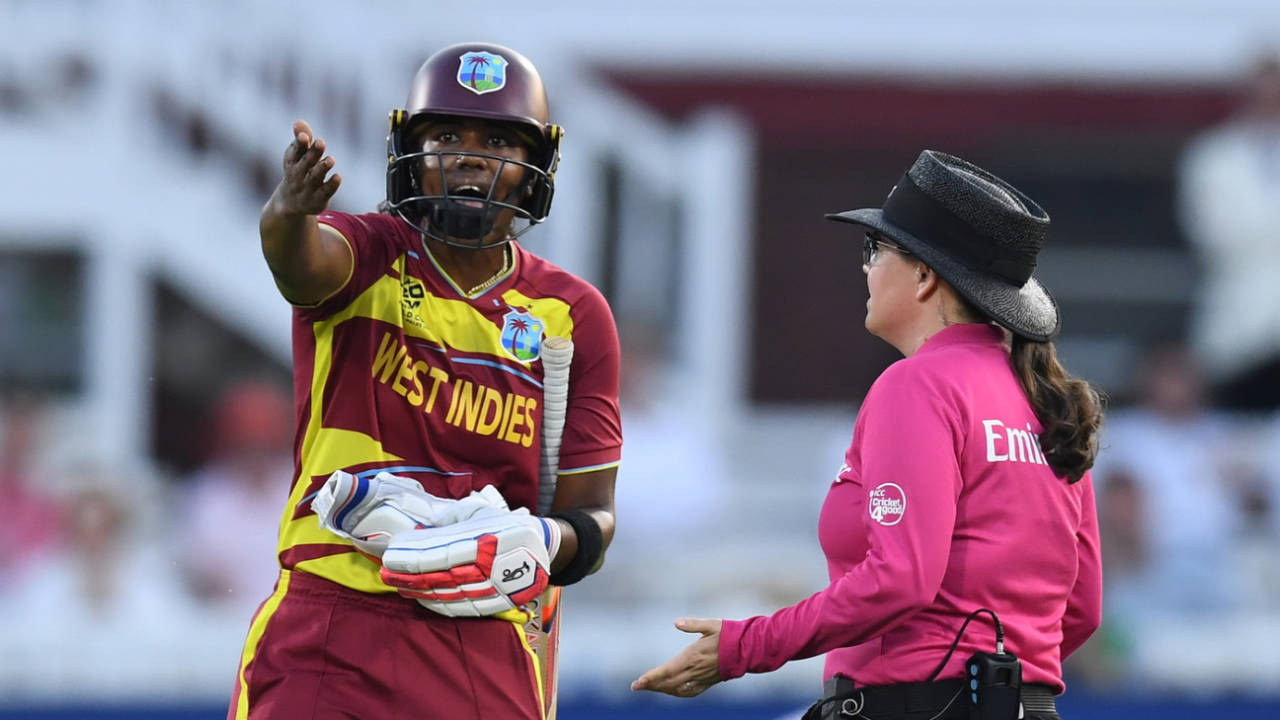
The cricketing world once again found itself debating the nuances of technology following a contentious Decision Review System (DRS) call that saw West Indies captain Hayley Matthews dismissed during her side’s 38-run defeat against England in the T20 World Cup at Lord’s. Matthews was given out caught behind, despite visual replays appearing to show a clear gap between her bat and the ball. The incident left the star all-rounder visibly frustrated, further fuelling discussions around the precision and interpretation of edge detection technology in high-stakes matches.
Contents
A Controversial Dismissal Unfolds
The pivotal moment occurred in the fourth over of West Indies’ chase, with Matthews at the crease. Facing England spinner Linsey Smith, Matthews attempted a cut shot, after which England wicketkeeper Amy Jones immediately appealed for an edge. On-field umpire N Janani, however, remained unmoved, prompting England’s stand-in captain Charlie Dean to signal for a review, a decision that would soon spark significant controversy.
Initial video replays broadcast did not reveal a conclusive deflection off the bat, though the ball passed perilously close. The focus then shifted to the TV umpire, Nimali Perera, who proceeded to consult UltraEdge technology. This system subsequently displayed a spike, indicating potential contact between bat and ball. Yet, crucially, on the precise frame where this UltraEdge spike was visible, the front-on replay seemed to depict a noticeable gap between the bat and the ball’s trajectory.
Umpire Perera acknowledged the apparent discrepancy, noting the gap on the visual evidence, and took additional time to meticulously re-review the available footage. Matthews, meanwhile, stood anxiously awaiting her fate on the field. After careful consideration, Perera ultimately concluded that there was sufficient evidence to substantiate contact, subsequently advising the on-field umpires to overturn their original ‘not out’ verdict. The decision sparked immediate disbelief among many spectators and pundits alike.
Matthews’ Strong Disagreement and Post-Match Comments
The reversal of the decision led to a visibly unhappy Matthews remonstrating with on-field umpires Janani and Eloise Sheridan before begrudgingly departing the field. Her displeasure continued on the sidelines, where she was observed intently watching replays of her dismissal alongside head coach Shane Deitz on the West Indies bench. Later, she was seen in discussion with reserve umpire Kerrin Klaaste outside the boundary rope, clearly still processing the controversial call.
During the host broadcast, former England international Ebony Rainford-Brent remarked that the commentary team had not detected any audible noise on the stump microphone—a detail often used to corroborate edges. In her post-match press conference, Matthews firmly reiterated her belief that she had not hit the ball, suggesting the noise detected by UltraEdge might have originated from another source.
During her post-match press conference, Matthews elaborated on the incident. She recounted hearing a noise when attempting the cut shot, which she initially attributed to her bat handle. Matthews immediately informed the on-field umpires of what she heard, emphasizing her belief that she was “far away from the ball”. While acknowledging the TV umpire’s reliance on technology, Matthews expressed her strong feeling that a “clear gap between bat and ball” was visible, though ultimately conceding the necessity to “respect that” decision.
The Ongoing Debate Surrounding Edge Detection Technology
Matthews’ controversial dismissal is far from an isolated incident; it represents the latest in a series of events that have cast a critical spotlight on edge detection technology in cricket. Similar controversies involving the ‘Snicko’ system arose during the 2025-26 Men’s Ashes series, where several decisions based on faint spikes and inconclusive visual evidence led to widespread debate among players, commentators, and fans. These recurring issues highlight the ongoing challenge of perfectly integrating advanced technology into the subjective and fast-paced nature of cricket umpiring, raising questions about the threshold of ‘conclusive evidence’ required for overturning on-field decisions.
Form and Future for the West Indies
Beyond the contentious DRS call, Matthews’ recent batting form has also been a talking point. After an impressive 48 in West Indies’ opening victory against New Zealand, her subsequent scores have been modest: 14 off 22 against Scotland, 17 off 17 against Sri Lanka, and 14 off 17 against England. Despite her personal struggles, Matthews remains optimistic about the team’s overall progress.
Matthews acknowledged her recent dip in form, stating the need for her to contribute more runs. She also noted that fellow key player Deandra Dottin had not been at her absolute best. Despite this, Matthews highlighted the team’s ability to secure victories and remain competitive, seeing it as a positive sign. She reflected on a time when the team’s success was heavily dependent on her or Dottin performing exceptionally. The current situation, where she and Dottin have been “struggling” and other players like Chinelle Henry are stepping up, demonstrates a broader reliance on the squad’s depth, a promising development for West Indies cricket.
The West Indies currently hold second place in Group 2, boasting three wins from four matches. This places them just behind hosts England, who have already secured their semi-final berth. A crucial victory for West Indies in their final group fixture against Ireland on Saturday would guarantee their qualification for the last four. However, a defeat would open the door for New Zealand and Sri Lanka, who could potentially surpass West Indies on net run rate should they win their respective final matches. The stakes are incredibly high, and the team will be eager to put the controversy of the England match behind them as they focus on securing their place in the knockout stages.