The day Sir Don Bradman reached a hundred in only three overs

Contents
A Legacy of Unprecedented Aggression
Scoring quickly has become the new normal in modern cricket. Across T20 leagues and ODIs, batters look to dominate from the very first ball instead of taking time to settle in. Players like Abhishek Sharma, Travis Head, Ishan Kishan, and the emerging talent Vaibhav Sooryavanshi have captured the imagination of fans with their fearless brand of cricket. Sooryavanshi, in particular, grabbed headlines with a stunning 35-ball century during the 2025 IPL, proving that age is no barrier when taking on the world’s best bowlers. Yet, long before the advent of T20 cricket, the legendary Sir Donald Bradman produced an innings that would still be considered unbelievable by today’s standards.
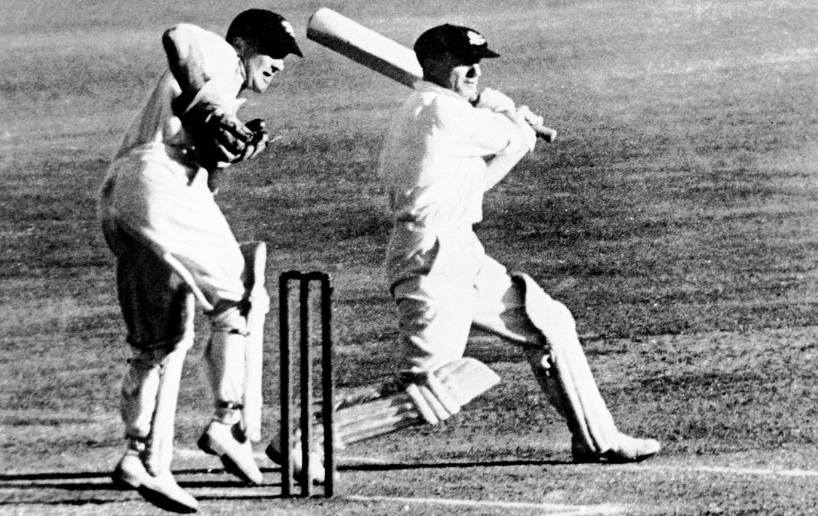
Sir Don Bradman. (Credits: X.com)
The Incredible Feat of 1931
The Australian icon was playing a domestic match for Blackheath against Lithgow when he unleashed one of the fastest centuries the game has ever seen on November 2, 1931. While modern cricket fans celebrate quickfire hundreds, the historical reality is that the day Sir Don Bradman reached a hundred in only three overs remains a statistical anomaly that feels almost impossible to replicate.
The achievement becomes even more staggering when one considers the structure of the game during that era. In Australia, at the time, overs consisted of eight balls each. This means that Bradman required only 22 deliveries to reach his three-figure mark, a strike rate that would leave even the most aggressive contemporary T20 finishers in awe.
Breaking Down the Numbers
The destruction began immediately. Bradman amassed 33 runs in the opening over, followed by 40 in the second, and a final 27 in the third to cross the century threshold. The Lithgow bowlers were left helpless as Bradman dismantled their attack, ultimately constructing an innings that featured 29 fours and 14 sixes, leading him to an unbeaten total of 256 runs.
Such was the ferocity of his batting that the boundaries seemed to shrink. Every delivery found its way to the rope or over it, creating a spectacle that was decades ahead of its time. It was a display of pure timing, intent, and unparalleled hand-eye coordination.
An Accidental Masterpiece
Perhaps the most fascinating aspect of this legendary innings is that it was entirely unplanned. Bradman himself reflected on the events in later years, noting the serendipitous nature of his performance. He famously stated, “It’s important, I think, to emphasise that the thing was not planned. It happened purely by accident and everyone was surprised at the outcome, no one more than I.”
Bradman recalled how his batting partner, Wendell Bill, became a footnote in history simply by witnessing the carnage from the non-striker’s end. Bill often joked in later years that he received more notoriety for the two singles he scored during those three overs than for any other accomplishment in his lengthy cricketing career. This anecdote highlights just how overwhelming Bradman’s presence was at the crease that day.
Why This Record Still Matters
While the modern game rewards high-risk shot-making, Bradman’s performance was rooted in a profound ability to manipulate the field and capitalize on every opportunity. In a world of sports where records are meant to be broken, this particular feat stands as a pillar of historical dominance. It reminds us that while the format of cricket has evolved from the slow-paced tests of the early 20th century to the high-octane excitement of the IPL and beyond, the spirit of aggressive, game-changing batting has always been an inherent part of the sport’s greatest players. Sir Don Bradman remains the benchmark, not just for his consistency, but for his capacity to change the complexion of a match in the blink of an eye.